Presentation
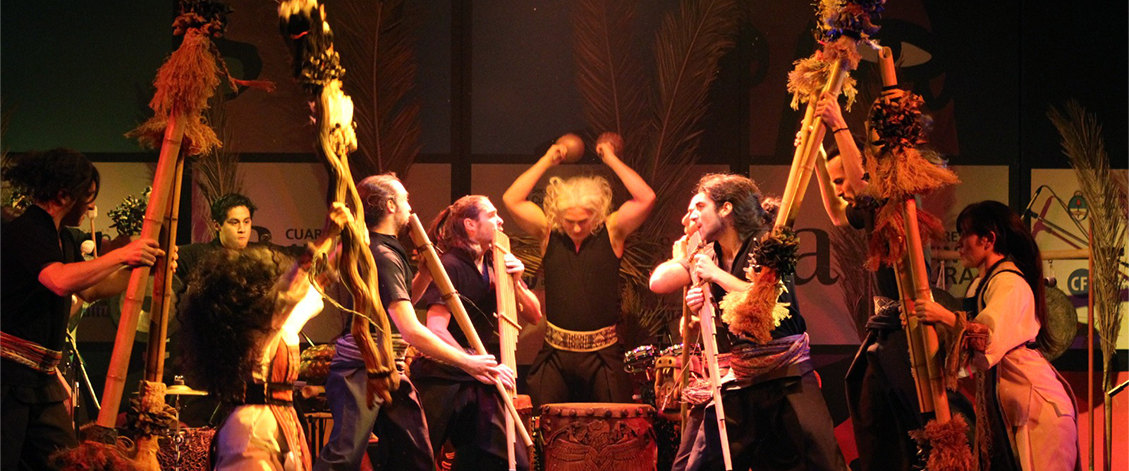
The Research and Creative Center for Traditional and Avant-Garde Arts IDECREA “Dr. Isabel Aretz” emerges from the convergence of three intertwined paths:
- Ethnomusicological and historical research, which turns to indigenous sources to collect and recover the last traces of a culture often forgotten, yet still forming the deep and enduring fabric of our existence.
- Contemporary artistic creation—both instrumental and electronic—seeking new forms of expression that reinterpret those genuine roots, continuously renewed by those who recognize their connection to their origins.
- Exploration of iconographic expressions within indigenous cultures, serving as inspiration for the development of contemporary visual art and bodily expression that embrace their heritage and find strength in their ancestral roots.
IDECREA “Dr. Isabel Aretz” was founded on the conviction that, through both ethnomusicological research and artistic creation, it is possible to bring together the scattered and forgotten elements that have long caused a disconnection—and at times even a rupture—with our cultural heritage. Guided by this purpose, IDECREA seeks to reestablish contact with the native sources of the Americas—not as an idealized return to a buried past, but as the awakening of a dormant seed that only needs a creative spirit to nurture it, allowing it to bear new and original fruit within the contemporary forms, structures, materials, and technologies of our time.
Far from rejecting the contributions of modernity, we aim for integration—a way to renew and re-signify what it means to be American.
The driving spirit behind this endeavor is also to inspire future generations to face the challenges of their time with conceptual frameworks worthy of the dreams of our liberators—those who believed that America was capable of originality. As Simón Rodríguez, mentor and friend of Simón Bolívar, once said: “Let us, once and for all, cease to be merely owners of our land, so that we may become owners of ourselves.”
Perhaps then, being American will no longer simply mean belonging to a geographical place, but rather a dignity each of us has truly earned.
ETHNOMUSICOLOGY PROGRAM
The ethnomusicological research carried out at IDECREA is grounded in the life’s work of Dr. Isabel Aretz, developed over decades of study, field research, collection and classification of materials, writing, publishing, lecturing, institution building, and the creation of visual and sound archives.
Objectives of the Program
- To establish an institutional space that houses and safeguards the material, intellectual, and artistic heritage donated by Dr. Isabel Aretz.
- To ensure the continuation of the spirit and vision that inspired her pioneering work.
There is still much to discover and study about our indigenous culture. The field of ethnomusicology remains inexhaustible, as its scope extends from the very origins of our traditions to the present day.
- Another key objective of the Institute is the dissemination of knowledge through film screenings, exhibitions, and seminars conducted by IDECREA members as well as by invited scholars and artists.
The materials preserved in our archives are living resources. When carefully selected, they serve as educational tools and as inspiration for artistic creation—allowing new generations to draw from them and forge an art and culture with their own authentic identity.
PROGRAM FOR ICONOGRAPHIC AND CORPOREAL RESEARCH IN SACRED ART
Research within the Program for Iconographic and Corporeal Studies in Sacred Art
Throughout all times and cultures, spiritual traditions have expressed—through iconographic art—their understanding of the world, of humanity, and of the universe: the very cosmovision in which their culture takes root. Sacred art manifests itself across all traditions as an art of evocation of the invisible through the transfiguration of the visible. The conception of sacred art is grounded in precise principles and rules that allow for the creation of works capable of immersing and elevating the beholder toward that invisible, archetypal reality—imperceptible to the physical eye. These foundations are shared by all traditions: only symbol can transcend the limits of rationality and awaken the spiritual senses. The human body stands as the ultimate symbol—the temple through which we may access this hidden yet ever-present reality woven into the deepest fabric of our being. The corporeal and introspective research developed by Lic. Susana Ferreres seeks an organic integration with the ritual dimension of human postures and gestures—forms that have been preserved in the iconography of native cultures: in their sculptures, murals, masks, and codices, and that some communities continue to keep alive today. “Icon,” from the Greek eikon, means “image.” The icon is theology in beauty. On the level of archetypal structures, the creation of the world already contains the seed of its ultimate calling and defines the destiny of humankind. As iconographic tradition teaches: “God grants us the grace to partake in His own beauty.” As Eugraph Kovalevsky, iconographer and poet of the past century, beautifully summarized: “The true image is transparency. In its subtle beauty, it invites the spirit to go beyond. It captures us for an instant, yet does not cling to our gaze; it withdraws, so that we may seek the higher realities it represents. The true image lifts us from the visible to the unimaginable.”